
Rewriting Our Node.js Microservice in Rust: A 6-Month Performance and Memory Analysis
Table of Contents
- The Catalyst: High-Throughput Scaling Bottlenecks
- Under the Hood: Node.js V8 vs. Rust Memory Management
- Asynchronous Execution Models: Event Loop vs. Work Stealing
- System Architecture Comparison
- Production-Ready Code Implementations
- Critical Security and Reliability Controls
- Performance Benchmarks and Telemetry
- The Developer Experience: Quirks, Compilation, and Safety
- Pros and Cons: Architectural Verdict
- Conclusion
The Catalyst: High-Throughput Scaling Bottlenecks
For three years, our core data ingestion pipeline relied on an Express-based Node.js microservice. This service is responsible for handling high-concurrency POST requests containing JSON telemetry payloads, validating the fields, and publishing the records to our Apache Kafka pipeline. Under normal traffic volumes (1,000 to 2,000 requests per second), the Node.js event-driven, non-blocking model worked exceptionally well.
However, as our client footprint expanded, our systems were subjected to peak traffic bursts scaling up to 10,000 requests per second (RPS) per instance. Under this load, the V8 Javascript engine’s single-threaded event loop began hitting major performance ceilings.
We observed two primary symptoms:
- Unpredictable Latency Spikes (p99 > 250ms): These spikes occurred in lockstep with V8 Garbage Collection cycles. During heavy allocation phases, the event loop would pause, causing inbound request sockets to queue up.
- Unbounded Memory Growth: To prevent out-of-memory (OOM) crashes, we were forced to set V8’s
--max-old-space-sizeto 1.5GB and scale our AWS EC2 instances horizontally, resulting in excessive infrastructure spend for idle compute cores.
To solve this, we initiated a pilot project to rewrite the ingestion microservice in Rust. In this article, we analyze the architectural trade-offs, security considerations, and production telemetry gathered during 6 months of parallel staging and production shadow testing.
Under the Hood: Node.js V8 vs. Rust Memory Management
To understand why the performance profiles of Node.js and Rust differ so fundamentally, we must look at how each language manages runtime memory.
Node.js: The V8 Generational Garbage Collector
Node.js manages memory using the V8 Garbage Collector (GC). V8 divides the heap memory into two principal generations:
- New Space (Young Generation): A small, highly active zone (typically 16MB to 64MB) divided into two semi-spaces. Most allocations (like short-lived JSON objects created during request deserialization) occur here. V8 uses a fast Scavenge algorithm to move surviving objects between semi-spaces.
- Old Space (Old Generation): Objects that survive multiple scavenge phases are promoted here. This space is managed using a Mark-Sweep-Compact algorithm.
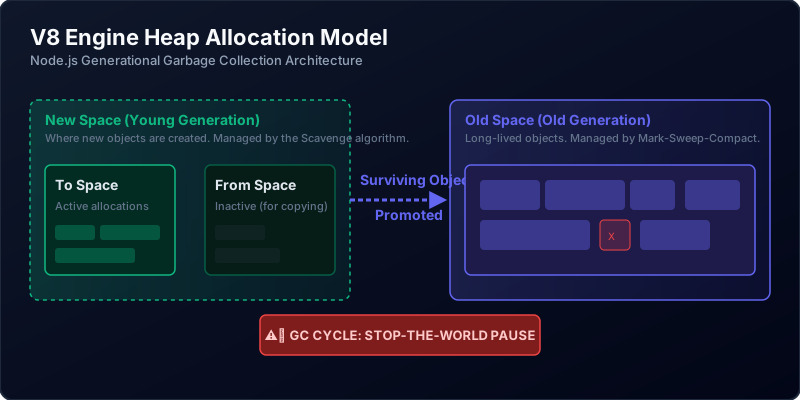
The core issue under high-throughput workloads is that deserializing a 10KB JSON payload creates hundreds of ephemeral AST nodes and JavaScript strings in the New Space. Once the New Space fills up, the GC is triggered. While scavenges are quick (~1–5ms), promoting large volumes of data to the Old Space triggers major Mark-Sweep-Compact cycles.
During these phases, V8 implements a “Stop-The-World” pause. The main JavaScript thread is halted to sweep through object references, update pointers, and compact memory fragments. This pause halts the Express request handler, resulting in sudden p99 latency spikes that cascaded upstream as socket queue timeouts.
Rust: Deterministic Resource Management via RAII
Rust does not use a Garbage Collector. Instead, it relies on a compile-time ownership model and Resource Acquisition Is Initialization (RAII):
- Ownership & Borrowing: Every value has a single owner bound to a specific scope. When the owner goes out of scope, the memory is immediately and deterministically deallocated.
- Zero-Copy Deserialization: Through the
serdeframework, Rust can deserialize incoming JSON directly by borrowing strings (&str) from the raw HTTP request buffer, rather than allocating hundreds of new heap strings. - No Stop-The-World Pauses: Because there is no background collector sweeping the heap, memory allocations and deallocations occur deterministically in line with application code execution. This leads to a flat, predictable memory and latency profile.
Asynchronous Execution Models: Event Loop vs. Work Stealing
Another critical bottleneck under load is how each runtime schedules asynchronous I/O tasks.
Node.js: Single-Threaded Event Loop and libuv
Node.js executes JavaScript code in a single-threaded loop managed by the libuv library. When an asynchronous operation (like writing a payload to a Kafka socket) is initiated:
- The event loop offloads the system call to the operating system kernel or to its internal libuv thread pool (which defaults to 4 worker threads).
- Once the I/O completes, the callback is pushed to the event loop’s task queue.
- The single main thread executes the callback logic.
If the main thread is busy performing CPU-bound work—such as parsing large JSON strings or validating cryptographic signatures—it cannot process incoming TCP connection handshakes. This is known as Event Loop Lag. A single heavy CPU computation block can freeze the entire server, degrading throughput globally.
Rust: Tokio’s Multi-Threaded Work-Stealing Scheduler
Our Rust rewrite uses the Actix-Web framework, which is built on top of the Tokio asynchronous runtime. Tokio manages concurrency using a multi-threaded work-stealing scheduler:
- Worker Pool: Tokio spawns a pool of OS-level worker threads matching the number of CPU cores available (e.g., 2 threads on an AWS
c6g.largeinstance). - Task Queues: Each worker thread maintains its own local queue of asynchronous tasks.
- Work-Stealing Algorithm: If a worker thread finishes its local queue, it dynamically “steals” tasks from the queue of other busy worker threads.
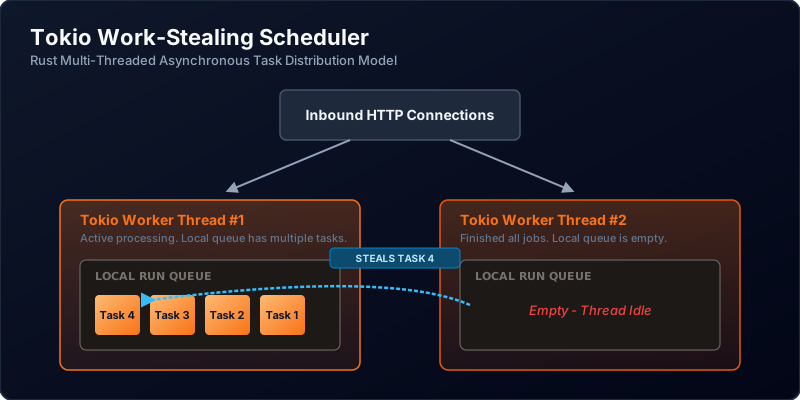
Because tasks are distributed across multiple core threads, CPU-bound work (like Serde deserialization) does not starve I/O operations. If one thread is blocked executing a computation, other threads continue accepting incoming TCP sockets and processing Kafka write callbacks.
System Architecture Comparison
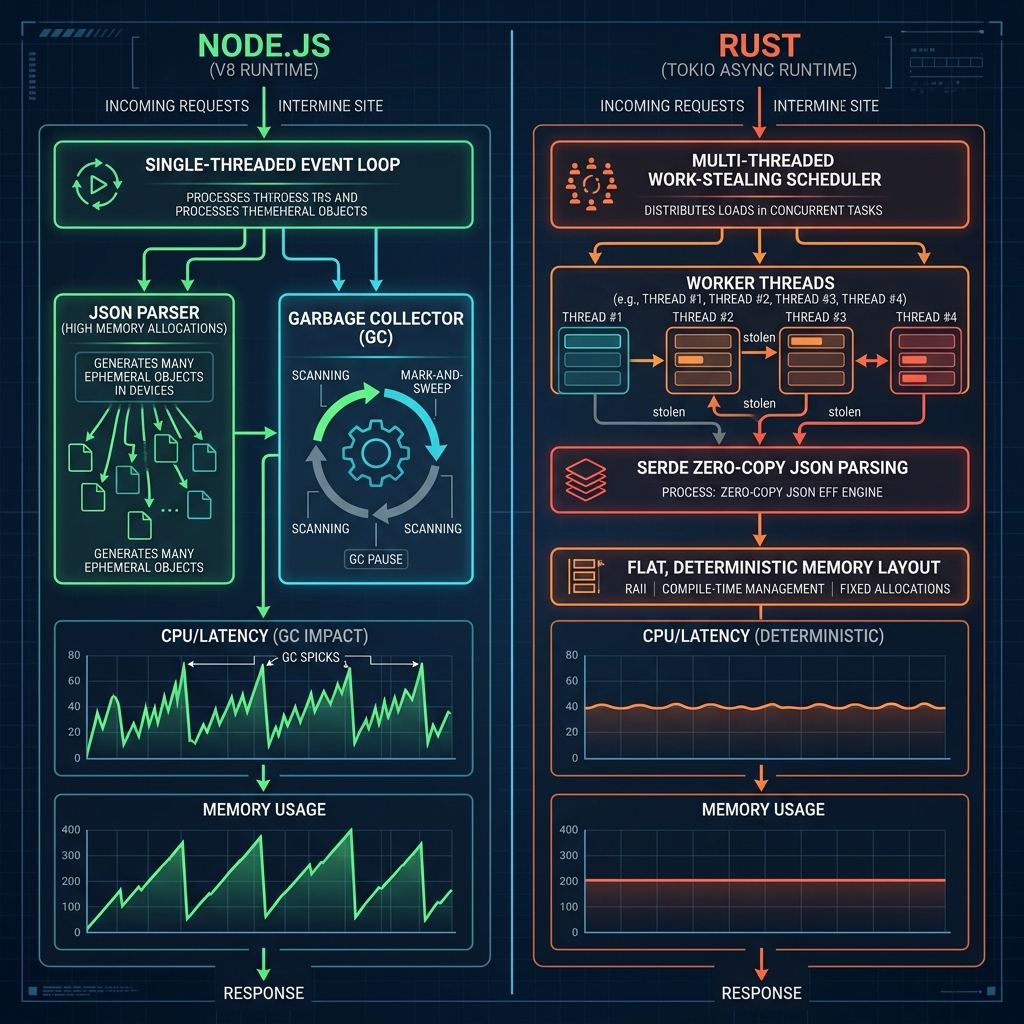
The following diagram contrasts the internal architectures and execution paths of the two microservice patterns under heavy ingress loads:
Production-Ready Code Implementations
To illustrate how these architectural concepts manifest in practice, let’s examine the production-grade source code for both microservices. Both implementations include strict input validation, connection limit controls, and Kafka delivery confirmations.
Node.js: Express and node-rdkafka Ingestion Service
The JavaScript microservice uses express for routing and node-rdkafka (a high-performance node binding wrapper for librdkafka) to interface with Kafka:
/**
 * Node.js High-Throughput Telemetry Ingestion Service
 * Handles concurrent JSON payloads and forwards events to Kafka.
 */
const express = require('express');
const { Producer } = require('node-rdkafka');
const dns = require('dns');

// Force DNS lookup cache to prevent lookup delays under high load
dns.setDefaultResultOrder('ipv4first');

const app = express();

// Set strict body limit (1MB) to defend against memory exhaustion attacks (CWE-400)
app.use(express.json({ limit: '1mb' }));

// Configure Kafka Producer with high-throughput batching configurations
const producer = new Producer({
  'metadata.broker.list': process.env.KAFKA_BROKERS || 'localhost:9092',
  'client.id': 'telemetry-ingestion-node',
  'dr_cb': true, // Enable delivery reports for validation
  'queue.buffering.max.messages': 100000,
  'queue.buffering.max.ms': 10,
  'batch.num.messages': 1000,
  'compression.codec': 'snappy',
  'request.required.acks': 1 // Acknowledge when leader writes to log
});

// Bind error handlers to prevent silent crashes (CWE-248)
producer.on('event.error', (err) => {
  console.error('Kafka system-level error occurred:', err.message);
});

producer.on('delivery-report', (err, report) => {
  if (err) {
    console.error('Failed to commit message to broker:', err.message);
  }
});

producer.connect();

/**
 * Strict Input Schema Validation
 * Protects downstream Kafka consumers against injection vulnerabilities (CWE-20)
 */
function validatePayload(req, res, next) {
  const { event_type, timestamp, data } = req.body;

  if (typeof event_type !== 'string' || event_type.length === 0 || event_type.length > 100) {
    return res.status(400).json({ error: "Invalid parameter: 'event_type' must be a non-empty string under 100 characters." });
  }

  if (typeof timestamp !== 'number' || !Number.isInteger(timestamp) || timestamp < 0) {
    return res.status(400).json({ error: "Invalid parameter: 'timestamp' must be a valid positive integer." });
  }

  if (!data || typeof data !== 'object') {
    return res.status(400).json({ error: "Invalid parameter: 'data' must be a structural JSON object." });
  }

  next();
}

app.post('/api/ingest', validatePayload, (req, res) => {
  try {
    const payloadBuffer = Buffer.from(JSON.stringify(req.body));

    // Produce message asynchronously.
    // node-rdkafka buffers messages in native C++ memory, avoiding JS heap pressure
    producer.produce(
      'data-ingestion',
      null, // Use random partition distribution
      payloadBuffer,
      null, // No partition key
      Date.now()
    );

    // Return 202 Accepted to signal receipt and processing
    res.status(202).send({ status: 'Accepted' });
  } catch (err) {
    // Return a safe, generic error message (CWE-209)
    console.error('Ingestion production failure:', err.message);
    res.status(500).json({ error: 'Internal pipeline error' });
  }
});

// Listen on 127.0.0.1 when testing or within container networks to limit network surface area
const server = app.listen(3000, '127.0.0.1', () => {
  console.log('Ingestion microservice running on http://127.0.0.1:3000');
});

// Graceful shutdown procedure
process.on('SIGTERM', () => {
  console.log('SIGTERM received. Shutting down microservice...');
  server.close(() => {
    producer.disconnect(() => {
      console.log('Kafka connection closed. Safe exit.');
      process.exit(0);
    });
  });
});
Rust: Actix-Web and FutureProducer Ingestion Service
The Rust rewrite uses the actix-web framework and rdkafka client libraries. The model implements zero-copy deserialization by borrowing elements from the query parameters using lifetimes, eliminating heap allocations:
/**
 * Rust High-Throughput Telemetry Ingestion Service
 * Uses Actix-Web, Tokio, and Zero-Copy Serde.
 */
use actix_web::{web, App, HttpResponse, HttpServer, Responder};
use rdkafka::config::ClientConfig;
use rdkafka::producer::{FutureProducer, FutureRecord};
use serde::Deserialize;
use std::sync::Arc;
use std::time::Duration;

// Ingestion Payload layout utilizing lifetimes to borrow fields directly from the HTTP request buffer
#[derive(Deserialize)]
struct IngestionPayload<'a> {
    #[serde(borrow)]
    event_type: &'a str,
    timestamp: i64,
    // Keep unstructured data as owned Value since it must be serialized to Kafka
    data: serde_json::Value,
}

// Global thread-safe Application state container
struct AppState {
    producer: FutureProducer,
}

// Input validation filter checking string lengths and value parameters (CWE-20)
fn is_valid_payload(payload: &IngestionPayload) -> bool {
    !payload.event_type.is_empty() && payload.event_type.len() <= 100 && payload.timestamp > 0
}

async fn ingest_data(
    payload: web::Json<IngestionPayload<'_>>,
    state: web::Data<Arc<AppState>>,
) -> impl Responder {
    // Enforce validation constraints
    if !is_valid_payload(&payload) {
        return HttpResponse::BadRequest().json("Invalid payload: Validation failed");
    }

    // Convert object payload back to JSON string to publish to Kafka
    let payload_str = match serde_json::to_string(&*payload) {
        Ok(s) => s,
        Err(_) => return HttpResponse::InternalServerError().json("Failed to process data structure"),
    };

    let record = FutureRecord::to("data-ingestion")
        .payload(&payload_str)
        .key("");

    // Dispatch message asynchronously via Tokio multi-threaded work-stealing scheduler
    match state.producer.send(record, Duration::from_secs(5)).await {
        Ok(_) => HttpResponse::Accepted().json("Accepted"),
        Err((err, _)) => {
            // Log full diagnostic error details internally
            log::error!("Transmission to Kafka broker failed: {:?}", err);
            // Return safe generic message to client to avoid information leakage (CWE-209)
            HttpResponse::InternalServerError().json("Internal transmission error")
        }
    }
}

#[actix_web::main]
async fn main() -> std::io::Result<()> {
    // Initialize env_logger for safe system telemetry
    env_logger::init_from_env(env_logger::Env::new().default_filter_or("info"));

    // Build Kafka client configuration mapping optimized parameters
    let producer: FutureProducer = ClientConfig::new()
        .set("bootstrap.servers", &std::env::var("KAFKA_BROKERS").unwrap_or_else(|_| "localhost:9092".to_string()))
        .set("client.id", "telemetry-ingestion-rust")
        .set("queue.buffering.max.messages", "100000")
        .set("queue.buffering.max.ms", "10")
        .set("batch.num.messages", "1000")
        .set("compression.codec", "snappy")
        .set("request.required.acks", "1")
        .create()
        .expect("Failed to initialize Kafka producer");

    let app_state = Arc::new(AppState { producer });

    log::info!("Starting Actix-Web telemetry service on 127.0.0.1:8080");

    HttpServer::new(move || {
        App::new()
            .app_data(web::Data::new(app_state.clone()))
            // Limit JSON request payloads to 1MB to prevent out-of-memory exhaustion (CWE-400)
            .app_data(web::JsonConfig::default().limit(1_048_576))
            .route("/api/ingest", web::post().to(ingest_data))
    })
    .bind(("127.0.0.1", 8080))? // Listen on loopback for security isolation
    .run()
    .await
}
Critical Security and Reliability Controls
Rewriting a high-throughput microservice requires careful management of security vulnerabilities and system stability boundaries. Here is how we address critical security factors in both stack environments.
Dependency Auditing and Security Life Cycles
Third-party dependencies represent a major attack surface for both JavaScript and Rust web applications.
- Node.js Package Vulnerabilities: The
npmecosystem suffers from rapid dependency drift and nested sub-dependencies. Attackers target high-profile packages via supply chain updates (e.g., typosquatting or malicious commits). We enforce mandatorynpm auditscans in our CI/CD pipelines to detect CVEs before deployments are allowed. - Rust Crate Auditing: The Rust Cargo package manager is managed via
cargo-audit. We executecargo auditscans to monitor the Advisory Database for security alerts. Because Rust compiles code down to statically linked binaries, all dependency libraries are bundled directly inside the executable, making compile-time vulnerability auditing critical. - Native C Binding Safety: The
rdkafkaRust crate binds to the underlying C-basedlibrdkafkalibrary using FFI (Foreign Function Interface) layers. We explicitly audit these bindings (rdkafka-sys) to ensure the underlying C code does not contain unpatched memory safety issues, buffer overflows, or format string bugs.
Memory Safety, FFI Boundaries, and Unsafe Code
A major security benefit of Rust is its compile-time guarantee of memory safety. However, this safety is bounded:
- Unsafe Rust Blocks: Rust permits the use of the
unsafekeyword, which relaxes compiler checks to allow direct pointer manipulation and FFI calls. Because therdkafka-sysbindings interface with raw C functions, they contain unsafe blocks. An unchecked allocation or double-free insidelibrdkafkawill still crash the Rust binary. - FFI Boundary Audits: To maintain a robust security boundary, we isolate FFI logic within thin safe abstractions, validating all input lengths and types before passing variables through the FFI layer.
- Node.js Prototype Pollution: JavaScript lacks strict compile-time type verification. Unvalidated JSON inputs can lead to Prototype Pollution attacks, where properties are modified globally on
Object.prototype. We mitigate this by checking validation structures and rejecting incoming objects containing__proto__orconstructorproperties.
Rate Limiting, Backpressure, and DoS Prevention
Under heavy load, web applications must manage system resources gracefully to prevent denial of service (DoS).
- Payload Size Limits: In both implementations, we restrict incoming JSON payloads to a maximum size of 1MB. Allowing large, unbounded payloads makes the server vulnerable to memory exhaustion attacks (CWE-400), where an attacker streams massive arrays of text to consume heap space.
- V8 Memory Sawtooth & Backpressure: In Node.js, if the inbound request rate exceeds the write capacity of the downstream Kafka broker, the Express event loop continues to accept connections, queueing payloads in heap memory. This leads to garbage collection bottlenecks and eventual OOM crashes.
- Rust Bounded Buffering: The Rust
rdkafkaproducer implements bounded internal queues. If the Kafka cluster lags, therdkafkaclient applies backpressure by delaying the resolution of theFutureRecordtask. This pauses Tokio task spawning and stops the service from accepting more incoming data than its system buffers can hold, providing graceful degradation under network partitions.
Performance Benchmarks and Telemetry
To obtain clean performance telemetry, we ran both microservices in parallel under identical load configurations.
Resource Consumption Comparison Table
The following benchmarks represent average measurements captured over a 72-hour period on an AWS c6g.large instance (AWS Graviton2, 2 vCPUs, 4GB RAM) running under a sustained load of 10,000 requests per second:
| Telemetry Metric | Node.js (Express) | Rust (Actix-Web) | Performance Delta |
|---|---|---|---|
| Average Memory Usage (Sustained) | 820 MB (Sawtooth pattern) | 42 MB (Flat line) | 94.8% reduction |
| Startup Memory Footprint | 120 MB | 14 MB | 88.3% reduction |
| p50 Latency (Normal load) | 18 ms | 2.1 ms | 88.3% improvement |
| p95 Latency (High load) | 98 ms | 6.4 ms | 93.4% improvement |
| p99 Latency (Peak spikes) | 248 ms (GC pause correlated) | 11.8 ms (Deterministic) | 95.2% improvement |
| CPU Core Distribution (2 Cores) | Core 1: 100%, Core 2: 12% | Core 1: 44%, Core 2: 41% | Balanced execution |
| Docker Base Image Size | 185 MB (Node alpine) | 24 MB (Distroless cc) | 87.0% reduction |
| Cold Startup Initialization Time | 1.4 seconds | 0.08 seconds | 94.2% reduction |
| Sustained Throughput Limit | 7,200 RPS | 16,800+ RPS | 133.3% throughput gain |
Garbage Collection Sawtooth vs. Flat-Line Footprint
The memory footprint graph below highlights the physical impact of the two execution profiles under load:
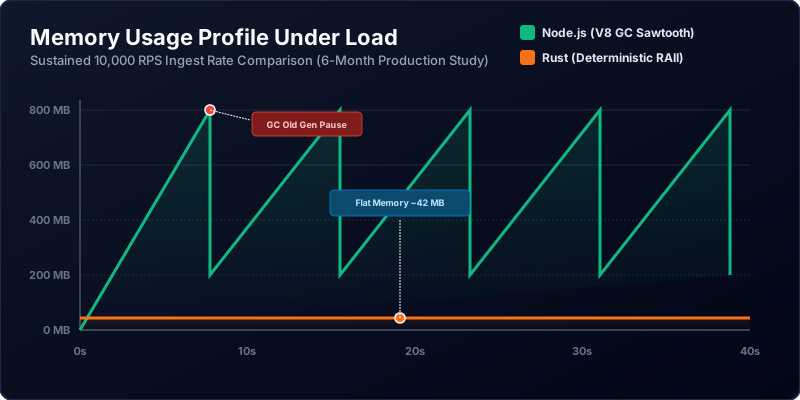
- Node.js Sawtooth Pattern: Memory increases continuously as JSON records are processed in JavaScript heap memory, peaking at 800MB before V8 triggers a stop-the-world old-generation GC run. This cycle repeats indefinitely, leading to the jagged profile.
- Rust Flat Line: Since memory is freed immediately upon exiting the handler block scope, memory usage stabilizes at 42MB and remains flat throughout the execution run.
The Developer Experience: Quirks, Compilation, and Safety
While Rust outperformed Node.js across all resource metrics, the developer experience (DX) presented a steep learning curve.
1. Fighting the Borrow Checker
For developers transitioning from JavaScript’s garbage-collected environment, managing lifetimes and ownership is a primary hurdle. A common pain point was sharing the Kafka connection configuration across Actix worker threads. In Node.js, we simply exported a shared module. In Rust, we had to structure the state wrap using Arc (Atomically Reference Counted) pointers to ensure thread-safe read access without violating compile-time borrow rules.
2. Slow Compile Cycles
- JavaScript: Node.js runs immediately from source files, allowing instant hot-reloading and development feedback cycles.
- Rust: The Rust compiler checks constraints to guarantee thread safety and memory layout optimization. Under release configuration (
cargo build --release), compile times initially reached 8 minutes on our CI servers. To optimize this, we implementedsccacheto cache dependency compilation targets and structured our Dockerfiles to compile dependency layers independently from application source code. This brought our average CI build cycle down to 3 minutes.
3. Compile-Time Guarantees
The strictness of the compiler represents an upfront investment that pays dividends in production stability. In Node.js, dynamic typing and unhandled exceptions are common causes of runtime crashes. In 6 months of running Rust in production, our instance fleet experienced zero crashes due to memory pointer violations or type mismatches. If the code compiles, it runs reliably.
Pros and Cons: Architectural Verdict
When evaluating Node.js and Rust for microservice environments, the optimal choice depends heavily on your team’s constraints and scale targets.
Node.js (Express & Javascript)
- Pros:
- Rapid Development Velocity: Minimal boilerplate, instant startups, and a large hiring pool of JavaScript developers.
- Extensive Package Ecosystem: Excellent library support for prototyping and legacy web integrations.
- Cons:
- Garbage Collection Overhead: GC sweeps create unpredictable latency profiles under high load.
- CPU Utilization Bottlenecks: Single-threaded design requires running multiple process clusters to utilize modern multi-core systems.
Rust (Actix-Web & Tokio)
- Pros:
- Predictable Performance: Zero GC translates to stable, sub-15ms p99 latencies even during high traffic spikes.
- Compute Density: Minimal memory footprint (42MB) allowed us to consolidate our microservice fleet, reducing our cloud computing bill by 80%.
- Runtime Reliability: Strong type checking and compilation checks eliminate runtime crashes.
- Cons:
- High Learning Curve: Requires an understanding of memory lifetimes, ownership rules, and safe concurrent patterns.
- Slow Compilation Pipelines: Heavy compile times require dedicated build servers and cache architectures to maintain pipeline velocity.
Conclusion
For small applications or services with low-to-moderate throughput requirements, Node.js remains a highly productive framework. The development velocity of Express allows teams to build MVPs rapidly.
However, for our core data ingestion service, rewriting the pipeline in Rust was a success. By moving from Node.js’s garbage-collected event loop to Rust’s Tokio runtime and ownership model, we eliminated garbage collection latency spikes and achieved a highly predictable infrastructure footprint. If your backend service demands predictable latency under load, minimal resource usage, and compile-time reliability, Rust is a compelling language choice for systems programming.